
 manar.mahmoud
Saudi Arabia is no longer just a regional player; it is a global economic powerhouse. Under the ambitious framework of Vision 2030, the Kingdom is undergoing a transformation that is as rapid as it is profound. From the rise of NEOM to the massive influx of foreign direct investment, the Saudi business landscape is a goldmine of opportunity. However, for international firms and local entities alike, there is a silent predator lurking in the digital shadows: The Terminology Trap.
As companies race to keep pace with this transformation, many are turning to Artificial Intelligence (AI) to handle their massive translation needs. It’s fast, it’s cost-effective, and it feels like the future. But in the high-stakes world of Saudi legal, financial, and governmental sectors, generic AI often falls short. It recognizes patterns, but it doesn’t understand the "why" behind the words.
In this post, we’ll explore why generic AI fails in the Saudi context and how Motqan’s hybrid, human-in-the-loop model provides the precision required to succeed in the Kingdom.
The Allure and the Ambush of Generic AI
Nowadays, AI translation is seen as an imperative need for businesses dealing with high volumes of content. If you have thousands of pages of technical manuals or hundreds of legal contracts, the speed of AI is seductive. However, there is a fundamental difference between a translation that is "readable" and one that is "legally and commercially valid."
Generic AI models, the ones trained on the broad, open internet, are "contextually blind." They process Arabic as a mathematical probability rather than a nuanced language of commerce. In the Saudi business sector, where specific terms are dictated by the Ministry of Commerce or the Saudi Central Bank (SAMA), a "close enough" translation is a recipe for a commercial disaster.

The Saudi Nuance: More Than Just "Arabic"
One of the biggest hurdles in AI translation is the assumption that Arabic is a monolith. In reality, the Saudi context requires a deep understanding of three distinct layers:
1. The Vision 2030 Lexicon
The transformation of the Kingdom has birthed a new vocabulary. Terms related to "Giga-projects," "sustainability initiatives," and "digital transformation" have specific meanings within the Saudi government’s framework. A generic AI might translate a term literally, missing the strategic weight it carries in a government tender or a corporate proposal.
2. Legal and Regulatory Precision
In Saudi Arabia, Arabic is the mandatory language for all official government transactions and legal proceedings. If a supplier agreement uses an ambiguous term for "liability" or "indemnity" because the AI pulled a Levantine or Egyptian dialectical variation, the contract could be rendered unenforceable or, worse, carry unintended obligations.
3. The Dialectal Divide
While Modern Standard Arabic (MSA) is the gold standard for formal writing, the business environment in Riyadh (Najdi influence) often differs in tone and specific terminology from the commercial hubs in Jeddah (Hijazi influence). Generic AI often mixes these up, creating a "linguistic soup" that feels foreign to a local Saudi executive.

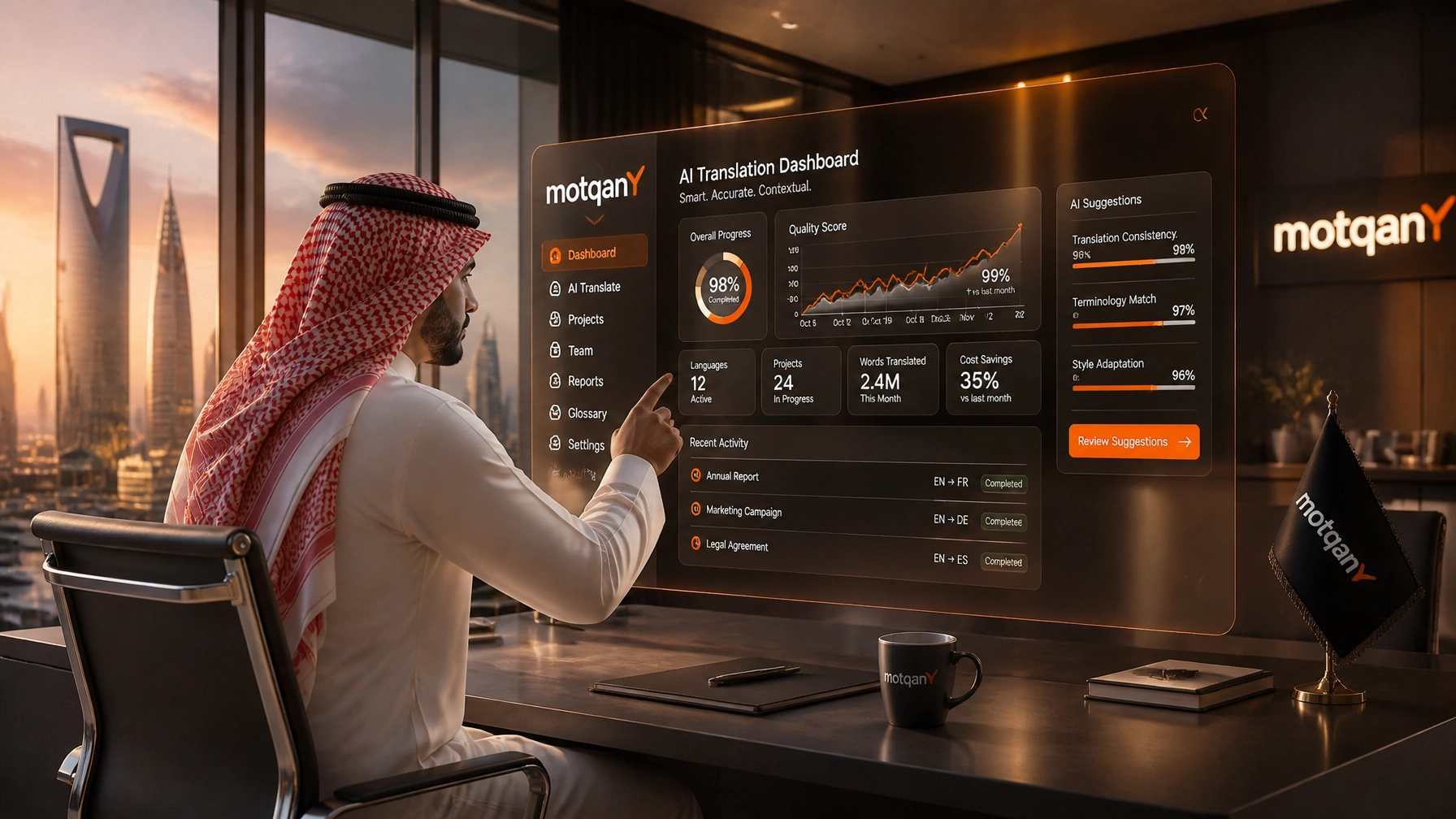
Visual Suggestion: A high-end, minimalist boardroom in Riyadh. A Saudi businessman in a crisp white thobe and red-and-white checkered shemagh (stiff collar, buttoned cuffs) is reviewing a digital contract on a sleek glass table. The aesthetic is professional and tech-driven.
Why Generic AI Falls Into the Trap
Why does this happen? Most AI models suffer from "hallucinations" or "contextual drift." Because they are trained on vast datasets, they often prioritize the most common usage of a word across the entire Arab world rather than the specific usage required in a Saudi courtroom or boardroom.
For example, a term used in a UAE financial filing might have a slightly different legal implication than the same term used under Saudi Arabia’s new Investment Law. Generic AI cannot distinguish these borders. It sees a word; it provides a match. It doesn't see the solutions required to bridge the gap between two different legal systems.
The Motqan Solution: Prompt Packs and Human-in-the-Loop
At Motqan, we realized early on that the answer isn't to reject AI, but to evolve it. We’ve moved beyond the "black box" of automated translation to a sophisticated Human-in-the-Loop (HITL) model.
Industry-Specific Prompt Packs
We don't just "hit translate." Our team has developed proprietary Industry-Specific Prompt Packs. These are highly specialized sets of instructions and glossaries that "prime" the AI before it ever sees your text.
- Legal Packs: Pre-loaded with Saudi-specific terminology for the Ministry of Justice.
- Financial Packs: Aligned with SAMA and IFRS standards as applied in the Kingdom.
- Tech Packs: Tailored for the specific jargon of Vision 2030's digital initiatives.
By using these packs, we force the AI to operate within a "Saudi-first" linguistic boundary, drastically reducing the risk of terminology errors.
The Human Touch
No matter how good the AI becomes, it lacks the "cultural gut feeling." Our certified native translators act as the final, critical filter. They don't just proofread for typos; they ensure the tone is appropriate for a Saudi audience and that the terminology aligns with the latest royal decrees or regulatory updates. This is how we ensure risk management in every document we deliver.

Boosting Accuracy through Consistency
One of the biggest failures of "cheap" AI translation is inconsistency. The AI might translate the word "Agreement" in three different ways within the same 50-page document. In a legal context, this creates loopholes.
Thanks to our integrated Terminology Management Systems, Motqan ensures that once a term is defined, whether it’s for a tech startup or a multinational oil & gas firm, it remains consistent across every page, every project, and every year. This "terminology memory" is what separates professional translation from a mere digital conversion.

Visual Suggestion: A minimalist close-up of a professional linguist’s hands at a modern workstation. On one screen, a complex Saudi regulatory document; on the other, a digital glossary highlighting specific terms. The lighting is clean and professional.
Moving Forward: Partner with Precision
The "Terminology Trap" is real, but it is avoidable. As you expand your footprint in Saudi Arabia, the question isn't whether you should use AI, but how you should manage it. Do you want your brand to sound like a generic algorithm, or do you want it to resonate with the authority and precision of a local leader?
Partnering with Motqan means you get the best of both worlds: the speed of cutting-edge AI and the nuanced reliability of human expertise. We don't just translate words; we translate your business goals into the Saudi context.
Evolve your communication. Unlock the full potential of the Saudi market. Boost your brand's credibility.
Would you like your business documents to reflect the high standards of Vision 2030? Partner with us today and ensure your terminology is never a trap, but a bridge to your success.
Frequently Asked Questions
1. Why is AI translation alone risky for Saudi business?
Generic AI lacks the specific legal and cultural context of Saudi Arabia. It can misinterpret regulatory terms, leading to non-compliance or legal ambiguity in contracts.
2. What is "Human-in-the-Loop" translation?
It is a process where AI handles the initial heavy lifting, but expert human linguists review, refine, and validate the output to ensure it meets professional and cultural standards.
3. Does Motqan handle specific Saudi dialects?
Yes. While business is conducted in Modern Standard Arabic, our translators understand the nuances between Najdi, Hijazi, and other regional variations to ensure your tone is perfect for your target audience.
4. How do Prompt Packs improve translation quality?
Prompt Packs act as a "guidebook" for the AI, providing it with specific Saudi-centric glossaries and stylistic rules before the translation begins, ensuring the AI stays within the correct context.
5. Is my data secure during the translation process?
Absolutely. We prioritize secure global communication and data handling, ensuring that your sensitive business and legal documents are protected throughout the workflow.


